Preserving the Past for Future Generations
National Historic Landmark, 11 historic structures, and 5 museums throughout 22 acres
(831) 624-3261
"The further backward you can look, the farther forward you are likely to see." – Winston S. Churchill
1770 1771 1773 1774 1789 1797
1700 1800 1900
Juan Rodriguez Cabrillo was the first european explorer to land in Monterey California in 1542, claiming the land for Spain. In 1601, The Spanish Viceroy, appointed explorer Sebastian Vizcaino to map and detail the California coastline that Cabrillo discovered 60 years prior. Vizcaino traveled with Carmelite friars and landed in Monterey in 1603. Vizcaino renamed the port Monterey Bay, after the Viceroy, and also named other prominent landmarks in the areas such as the Santa Lucia Mountains, Point Lobos, Monterey Cypress and Carmel River. Vizcaino and the Carmelite friars went ashore to hold the first mass in Monterey under the shade of a large oak tree. Which he described in his writing and was later used as a landmark for identifying Monterey bay in future expeditions.
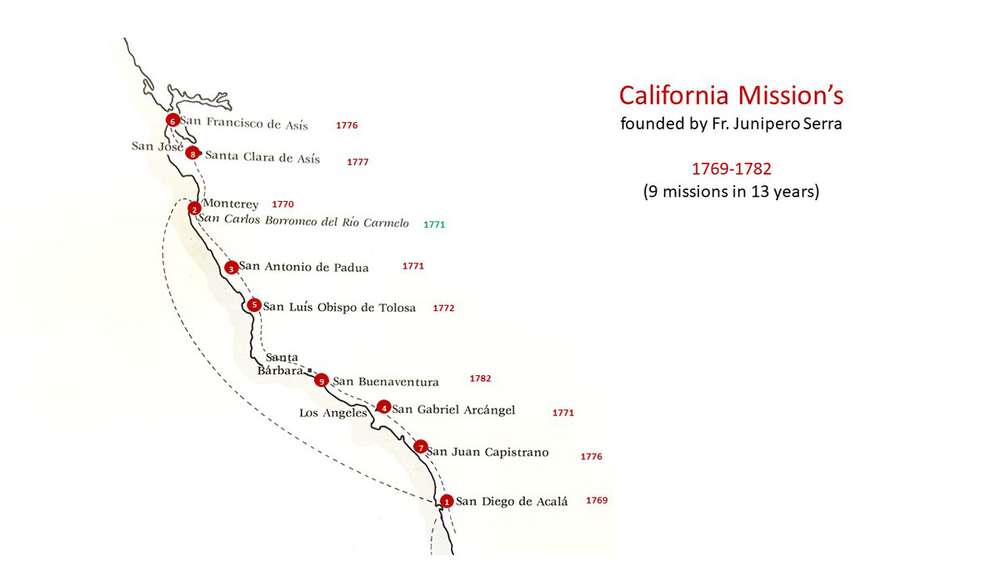
There was much excitement to establish a settlement in Monterey but with the change of the Viceroy the settlement plans were deferred another 167 years until 1770 when the Spanish aimed to establish ports on the Pacific Coast to facilitate their world-trading route. After missing Vizcaino's "Port of Monterey", Gaspar Portolá returned to San Diego to replenish their supplies and in 1770 set off on foot in search of this port from San Diego. Portola's boat, the San Antonio, was restocked and set sail for Monterey shortly after with Franciscan friars, Father Junípero Serra and Father Fermin Lasuén, on board. Father Serra reminded Portola of the great oak Vizcaino described and to look for it as a landmark of Monterey Bay. The San Antonio endured a six-week journey from San Diego up the Pacific Coast where they joined Portolá and Fr. Crespi who arrived by land and found that great oak and established the Presidio of Monterey and Mission San Carlos.
The Viscaino Serra Oak died in 1904 and was removed in 1905. A branch from this oak is preserved and on display in the Mission Museum today.
Sponsors & Partners