Restoration
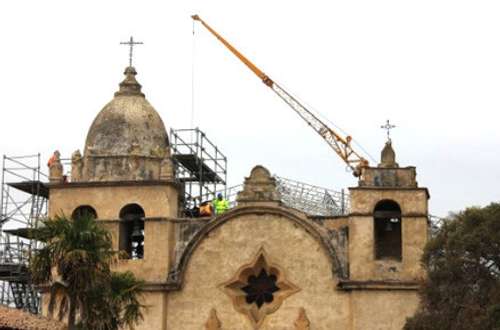
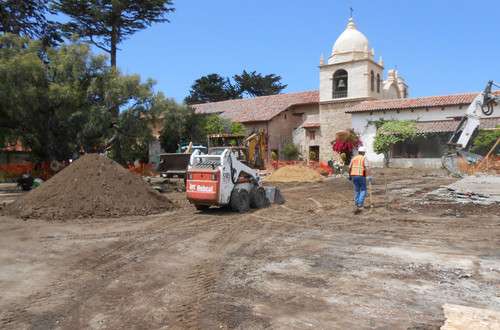
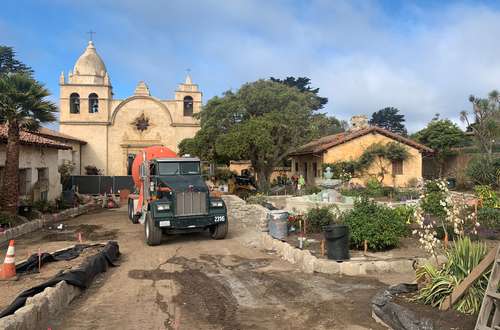
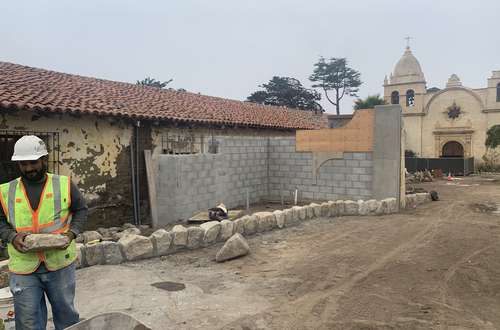
The Carmel Mission is in critical need of repair and restoration. Many of the
walls are over 200 years old and are fundamental to the structural
integrity and the architectural character of the Mission. The Mission’s
Basilica is one of a few California mission churches to be constructed
of stone.
|
 |
 |
 |
 |
| The
Basilica is a simple nave plan, 150’ by 29’ measured on the inside.
The walls are approximately five feet thick at the base. The interior
of the Basilica is unique among the mission churches in its wooden
tunnel vault ceiling, shaped in a parabolic arch (called by many
a reverse catenary arch) and spanning 29 feet. The planks forming
the vault are supported by three transverse faux stone ribs carried
on pairs of Doric pilasters projecting from the wall, reflected on
the exterior of the Basilica at these points by buttressing. |
 |
 |
 |
| The
walls and roof need to be reinforced to enhance structural integrity
and safety. Other work involves the repair and conservation of stone
walls and wood members, the installation of a fire suppressant system,
accessibility changes and electrical, communications, plumbing, heating
and mechanical upgrades. |
 |
HISTORICAL
RESTORATIONS |
 |
| Over
the years there were a series of building campaigns at the Mission.
Construction on the present Basilica began in 1793 and was completed
in 1797. Also at this time, adobe buildings were constructed to enclose
the Mission courtyard on all sides. All buildings fell into disrepair
during the mid-nineteenth century. The first restoration was undertaken
in the 1880’s by Father Casanova who raised necessary funds to put
a roof on the old church. |
 |
 |
In
the second quarter of the twentieth century a second restoration
effort was led by Harry Downie. The Basilica has maintained it
historical integrity and still retains a portion of its original
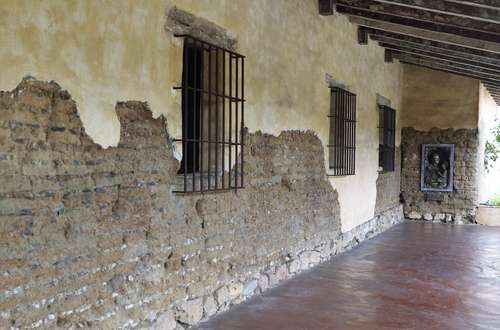
material, primarily in the stone walls. However, the historic buildings are now again in critical need of repair and
restoration with the last restoration work completed over 70 years
ago. Deterioration due to age and issues of structural integrity
must now again be addressed. The Basilica’s massive stone walls
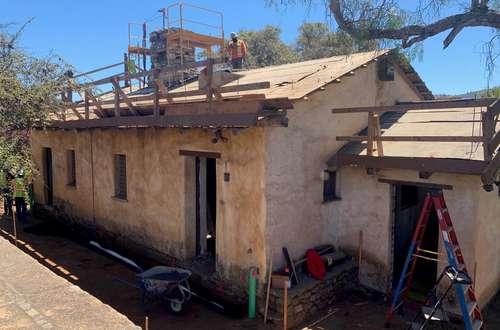
have cracks and flaking and in many locations historic wood lintels
and roof framing are severely deteriorated.
|
 |
 |
 |
CURRENT
RESTORATION
|
 |
| In 2008 a study was commissioned
to produce a Historic Structure Report for the Carmel Mission. This
report contained a history of its buildings, a discussion of their
significance, a preliminary assessment of existing conditions and
a code analysis. The Historic Structure Report thus became the impetus
for the current multi- year/multi-million dollar restoration project. |
 |
 |
 |
| The
restoration work is being performed under the supervision of a project
team highly experienced in historical preservation and restoration.
The team consists of a project manager, architect of record, preservation
architect, seismologist, hydrologist and civil, mechanical and structural
engineers.
Restoration priorities will begin with the Basilica.
The discovery, master planning and design phases of this multi-million
dollar project are now underway. These will be followed by final
construction drawings, permits and then the first building phase
which is scheduled for the summer of 2012, funds permitting. |
 |
 |
 |
| The
first building phase will require clay tile and roofing material
removal, existing planking removal for access to roof framing and
protection of the very significant parabolic ceiling from exposure
to the elements. Based on weather patterns of the California Central
Coast, there is typically a dry season from June through October,
providing a five month construction window to take the roof off and
get it
back on with minimal threat of moisture damage.
This means removing the roof, completing a seismic retrofit by stabilizing the
walls with drilled and grouted pin bars, which essentially inserts
a steel framework within the walls of the Basilica without affecting
its look, and strengthening existing trusses and knee braces. Concurrently,
the infrastructure for a fire suppressant system and electrical
and communications upgrades to replace all outside wiring and conduit
will be accomplished. Finally, roof decking will be replaced with
shear design to tie the roof structure to the walls, gutters will
be installed and re-roofing completed by replacing the clay tiles.
All of this needs to occur while the Basilica remains in continuous
use.
In order to accomplish this planned construction
work for the summer of 2012, funds are needed now
to build a reserve to cover these costs.
The Tricentennial Campaign is designed
to accomplish this. The ultimate goal is to have the Basilica
portion of the restoration project completed by November 2013,
in time for the Tricentennial of Father Junipero Serra’s birth.
When restoration is completed, the Mission will
be a safer, more efficient and more accessible environment. Following
completion of the Basilica, restoration will then turn to the Downie
Museum, the Convento, the Mora Chapel and the Blessed Sacrament
Chapel.
|
 |
Dates of construction of existing Mission buildings (Graphic by ARG, 2008) |
 |
| The
objective of all work being done is not just to remedy existing deficiencies,
but to ensure the preservation of the Mission buildings and artifacts
for future generations.

To learn more about the
different ways you can help, please visit our How to Help web page or click on the Donate button
below. Thank you.
|
|
 |
| HOME | ABOUT
US | HISTORY | RESTORATION | NEWS | CONTACT US | HELP US |
| |